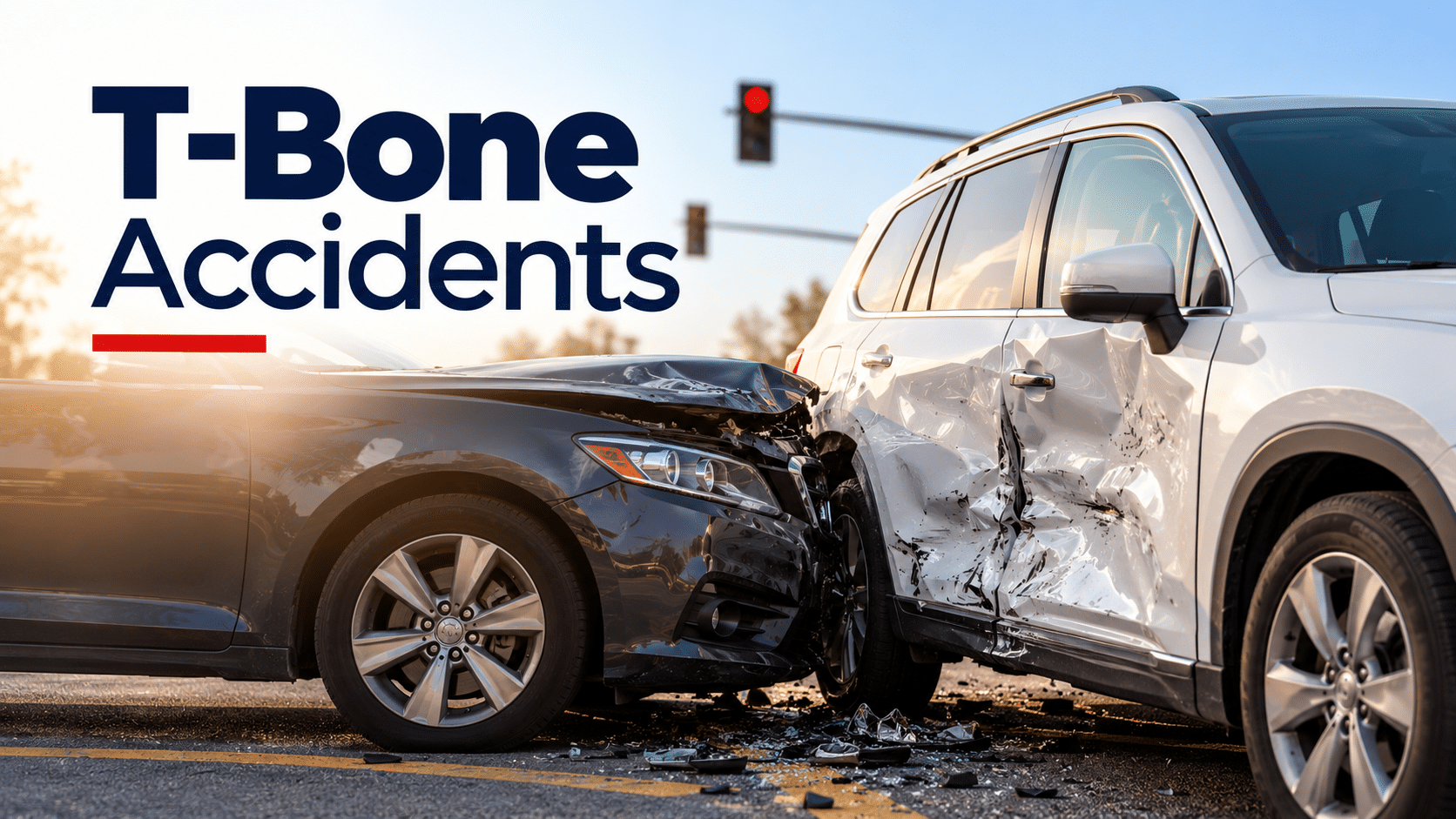
Few vehicular crashes are as sudden or physically violent as a T-bone accident. Often referred to as a side-impact crash, a T-bone accident occurs when the front end of one vehicle crashes directly into the side of another, forming a “T” shape.
When two vehicles collide perpendicularly, the occupants inside the struck car only have a thin door panel, window glass, and side-impact airbags to protect them from thousands of pounds of moving steel.
For victims, understanding how fault is determined under Missouri law, recognizing delayed injury symptoms, and gathering the right evidence early is critical to protecting your financial and physical recovery.
Who is at fault in a St. Louis T-Bone accident?
In Missouri personal injury law, fault is determined by negligence. Simply put, who failed to exercise the highest degree of care required of drivers behind the wheel? A common misconception among drivers is that whoever hits the other car is automatically the at-fault party. In reality, liability is not dictated by damage patterns. This means that in order to determine who is at fault, we need to establish who possessed the legal right-of-way, who violated traffic regulations, and how each driver acted leading up to the crash.
To determine who is liable, Missouri courts and insurance adjusters examine three primary scenarios:
1. Ignoring red lights and traffic signals
A driver who drives through a red signal or enters the intersection unlawfully is almost universally at fault. Typically in these cases, both drivers claim they had the green light.
Establishing liability requires securing video evidence from traffic feeds, dashcams, or nearby store surveillance systems before that digital data is overwritten.
2. Unsafe left turns across oncoming lanes
Under Missouri law, drivers making a left turn across traffic must yield the right-of-way to any oncoming vehicles that are within the intersection or close enough to constitute an immediate hazard.
If a driver turns left in front of you while you are traveling straight on a green signal, that driver is almost certainly at fault. However, if the oncoming motorist was driving without headlights at night, speeding significantly, or racing through a changing signal, comparative fault can shift liability back toward the oncoming car.
3. Failure to yield at signs and commercial exits
Many T-bone accidents occur outside of signal-controlled intersections. Drivers rolling through neighborhood stop signs, failing to yield at two-way stops, or blindly cutting across traffic from parking lot exits create immediate collision risks. Motorists already traveling on the throughway have the right-of-way, making the entering driver legally responsible for the ensuing side impact crash.
Similarly, at uncontrolled intersections, the driver on the left must yield to the driver on the right if both vehicles arrive at approximately the same time. Failing to respect these right-of-way rules constitutes clear evidence of driver negligence.
Other contributing factors to consider:
- Distracted driving: Texting, checking GPS apps, or handling infotainment systems causes drivers to miss signal transitions.
- Impaired driving: Alcohol and controlled substances severely impair depth perception, reaction timing, and speed judgment.
- Obstructed intersections: Overgrown foliage, illegally parked delivery vehicles, or missing traffic signage can complicate liability determinations.
Most common side impact crash injuries
The human body wasn’t made to take a hit from the side. When a car gets T-boned, your body is slammed hard against the interior, resulting in various painful injuries. Common side impact crash injuries include:
1. Head and traumatic brain injuries
When a car is hit from the side, an occupant’s head snaps violently toward the point of impact and then back. This lateral whip effect can slam the skull against side windows, the door pillar, or side-curtain airbags. Even without direct head contact, the sudden force causes the brain to strike the inside of the skull.
Symptoms of traumatic brain injury can be subtle at first, and include:
- Persistent dull headaches
- Dizziness and balance issues
- Sensitivity to light and sound
- Brain fog, confusion, or difficulty concentrating
- Mood fluctuations and unexpected irritability
2. Neck, back, and spinal cord trauma
Lateral whiplash can strain and tear the muscles and ligaments supporting the cervical spine. The severe shearing forces generated in a T-bone accident can result in:
- Herniated or bulging discs: Disc material pinches spinal nerves, sending shooting pain, numbness, and tingling down the arms or legs.
- Vertebral fractures: Cracked or shattered vertebrae requiring surgical stabilization.
- Spinal cord compression: Severe injuries that may lead to permanent loss of motor function, chronic nerve pain, or partial paralysis.
3. Pelvic, hip, and extremity fractures
Occupants seated on the struck side of the vehicle absorb enormous direct force through the hip and pelvis. Pelvic ring fractures and acetabular (hip socket) breaks are common, complex injuries that regularly require open surgery, internal fixation with plates and screws, and months of non-weight-bearing recovery.
4. Internal organ damage and chest trauma
Door intrusion often collapses inward against an occupant’s rib cage, leading to fractured ribs, punctured lungs (pneumothorax), and lacerations to spleen, liver, or kidneys. Internal bleeding is dangerous precisely because it may not cause immediate pain. Shock and adrenaline can mask profound internal trauma for hours following an accident.
5. Psychological and emotional trauma
The sheer shock of seeing another vehicle accelerate toward your door is hard to shake. Many side impact crashsurvivors experience Post-Traumatic Stress Disorder (PTSD), severe driving anxiety, panic attacks, and sleep disruption that affect their ability to return to work and daily life.
The critical evidence you need to win a T-Bone accident claim
Establishing fault requires objective, physical documentation that tells a coherent story. Naturally, both drivers will have contradictory narratives, which is why gathering independent evidence quickly is critical. This can include:
- Police reports: The investigating officer’s report provides diagrams, road condition notes, citations issued, and initial statements.
- Traffic camera & surveillance footage: Video from traffic monitoring systems, nearby commercial businesses, gas stations, or residential doorbell cameras is the best way to prove signal states.
- In-car dashcam footage: Real-time footage provides undisputed visual proof of right-of-way.
- Event Data Recorders (EDR): Modern vehicle “black boxes” capture precise pre-crash data, including vehicle speed, throttle position, brake application, and steering angles.
- Third-Party witness statements: Unbiased testimony from bystanders, pedestrians, or other drivers who saw the signal phases before the impact.
- Accident reconstruction analysis: In complex or high-stakes collisions, forensic reconstruction experts analyze skid patterns, vehicle crush depths, and resting positions to map the exact physics of the crash.
How Roach Law can help after a St. Louis T-Bone accident
If you or a family member has questions about your legal rights following a T-bone crash in St. Louis or anywhere across Missouri, contact Roach Law today.
Our skilled St. Louis personal injury attorneys will fight to recover the maximum compensation you deserve for your medical bills, lost wages, and long-term care.
Disclaimer
This article is provided for general informational purposes only and does not constitute legal advice. Reading this page or contacting Roach Law does not create an attorney-client relationship.